1990's PEZ Packaging Styles
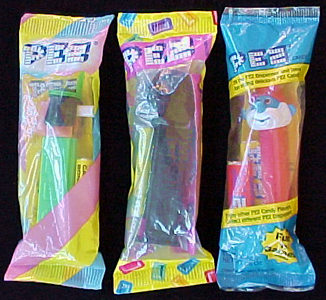
In
the 1990's, PEZ took their original idea of cellophane-wrapped
dispensers... gave them a 90's twist... and started
using sealed poly bags for their packaging. Each bag
contains a dispenser and two packs of candy. In the
picture on the left: the first bag is a Canadian overwrap
in the pastel stripe motif with a halo around the PEZ
logo; the middle bag is a Euro style design with the
newer "Floating Candies" design; and the third
bag is the traditional U.S. poly bag style. The US poly
bags, with the exception of holiday packaging, come
with either blue, red, or green colored ends on the
bags. For Christmas packaging, the bag ends are dark
green or dark red. For Halloween, PEZ uses orange on
the bag ends. And for Easter, the color scheme goes
to a pastel purple.
On
a technical note... the equipment PEZ uses to package
its dispensers and candies in a poly bag is called a
"Vertical Form and Seal" machine. Basically,
this machine takes a continuous web (spool) of preprinted
poly film, and forms the film around a funnel into a
continuous tube and seals the long running seam of the
bag (using heat). With the formed and long-seam-sealed
tube now at the bottom of the funnel, a set of jaws
clamp the bottom of the tube and seal it shut using
heat. At the same time the bottom seal is made, a dispenser
and two candy packs are dropped into the funnel, and
then on into the bag, with the dispenser and candy being
fed from two vibratory feeder bowls above the machine.
The lower sealing jaws then pull downward (still clamped
onto the bottom of the bag), and index the filled bag
down one position.
Next
the lower sealing jaws open up, and raise back into
the upper position. The jaws re-clamp back down on the
tube, which seals both the top of the filled bag and
seals the bottom seal for the next empty bag in line
to be filled. A cutter is incorporated in the sealing
jaws such that, when the two seams are sealed, the completed
filled bag is cut off of the film tube, while cutting
the bottom of the next bag in line. At the same time
that all of this is happening, the next dispenser and
candy packs are being dropped into the top bottom sealed
bag. This process then keeps on repeating.
Simple
in design, a Vertical Form and Seal machine is a very
efficient way to package product into bags. The movement
of all of its parts are very fluid, and these types
of machines are capable of packaging product at rates
from 20 to 40 bags per minute.
|
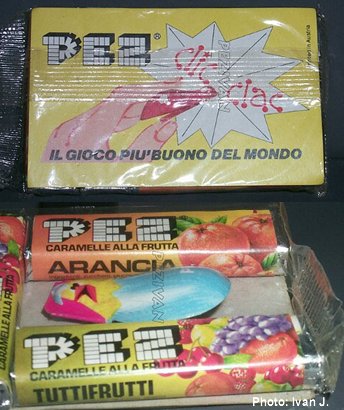
This
picture shows an Italian packaging bag for a PEZ Clicker
and three packs of candy.
|
|
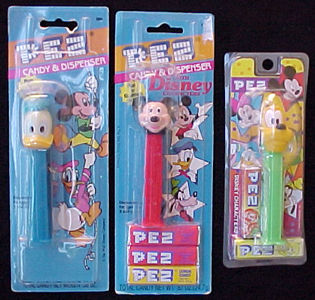
This
picture shows three different styles of carded packaging
for Disney dispensers. The blister pack on the left is
an older discontinued design. The card in the middle is
a recently discontinued graphic. The card on the right
shows the new Japanese blister pack and graphic design.
Note how much smaller the Japanese packaging is in comparison
to the US card sizes.
|
|
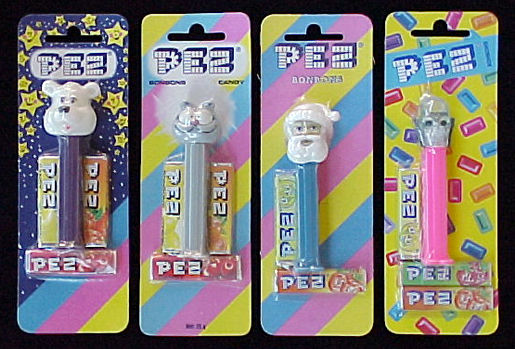
Pictured
above are three different Canadian card designs and a
Euro card graphic. The card on the left is called a Canadian
"Starry" card. This graphic was used on Christmas
dispensers, with this card showing a packaged Icee Bear.
The second card on the left is called a Canadian "Halo"
card. This style got its name from the halo that is printed
behind the head of the dispenser, as well as behind the
PEZ logo. The third card is in the traditional Canadian
pastel stripe motif. The fourth card is the Euro "Floating
Candies" card, which got its name from the scattered
candy design on the card graphic. An interesting thing
to note is that the Canadian and Euro packaging styles
use a shrink formed overwrap, as opposed to the US blister
pack design, to seal the dispenser and candy packs onto
the backing card.
A
technical note about shrink-formed overwrap packaging...
This style is manufactured very similarly to the blister
pack, with the following exceptions. Instead of a pre-molded
plastic blister, a plastic film is used. In blister packaging,
the dispenser and candy packs are placed into an empty
blister, and then the backing card is glued on (Click
here for a more complete description of how this is
done). In shrink-formed packaging, the printed backing
card is indexed on a conveyor past an operator that places
a dispenser and candy packs on the card. To keep the dispenser
from falling over on the flat card, PEZ started molding
a flat rib on the back of the head above the candy pusher.
This little ledge gives a flat surface to the back of
the head so it doesn't roll over.
The
card and product is then indexed into a shrink film packaging
machine. As the cards are indexed in, a thin plastic film
(fed off of a web coil or spool) is placed over the card/dispenser/candy
packs, and pulled down tight. The card is then run through
a heat tunnel that causes the film to shrink and tightly
seal the dispenser and candy packs against the card. As
the film shrinks, the plastic gets thicker and tightly
forms around the shape of the dispenser and candy packs.
When
the package exits the heat tunnel, the carded dispenser
is complete and ready for case packing.
|
|
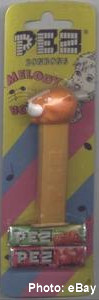 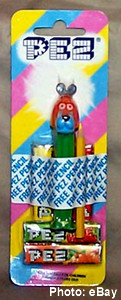 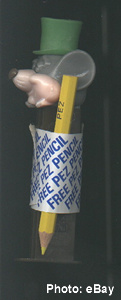 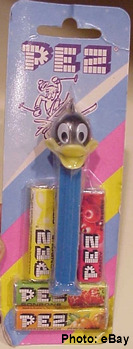
These
are some interesting packaging graphics. The card on the
left is a Canadian Merry Music Maker (MMM). Note the crossover
graphic that combines the older MMM graphic with the Canadian
pastel stripe motif. The second to the left card is a
Canadian card with a Free PEZ pencil included with the
dispenser. The third picture shows a loose Merlin Mouse
with a color pencil attached to the dispenser with a paper
band. The fourth picture shows an older Daffy Duck dispenser
with a snow skier graphic on top of the diagonal stripes.
|
|
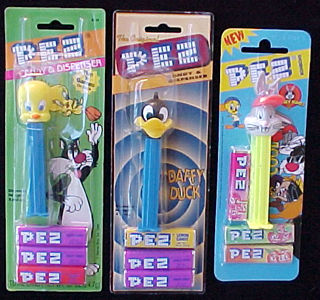 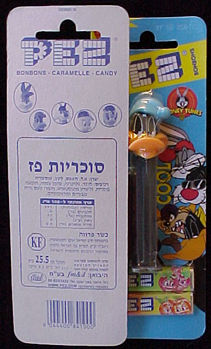
These
cards show various Looney Tunes card graphics. On the
picture to the left, the first card is a US blister pack
with the discontinued Sylvester and Tweety graphic, used
with 3.9 patent dispensers. The second card shows a US
blister pack card graphic that was used exclusively for
Warner Brothers stores. The third card is a Euro Cool
Looney Tunes card. Note the more colorful and artistic
graphics that are commonly found on all Euro cards. The
picture on the right shows the back of a Cool Looney Tunes
dispenser that is sold in Israel. The writing on the back
of the card is in Hebrew.
|
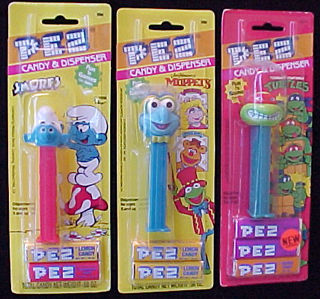
In
this picture, the card on the left shows the graphics
for a 3.9 patent Smurfs card. The middle card is a 3.9
Muppet card. And the card on the right is a 4.9 Teenage
Mutant Ninja Turtle card. During the 3.9 dispenser series,
PEZ typically included only two packs of candy with
the dispenser. PEZ started adding the third pack of
candy in the packaging with the 4.9 patent dispensers.
|
|
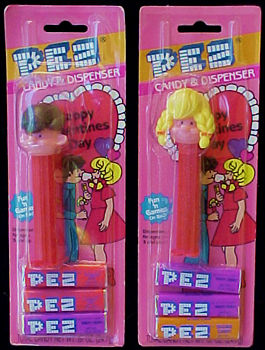
This
picture shows the PEZboy and PEZgirl on a US Valentines
card. Ahhh, it is true love! :-)
|
|
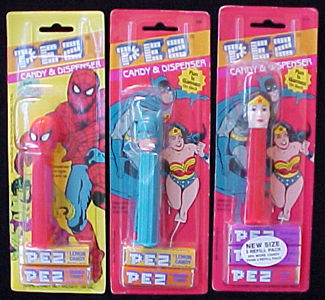 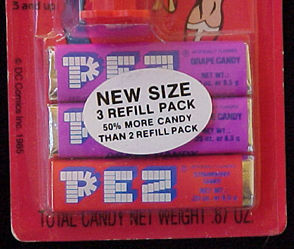
Here
are some Superheroes! Wonder Woman! I'm Batman! Spidey!
The two cards on the left are 3.9 patent dispensers with
two candy packs in the package. The Wonder Woman is a
4.9 patent dispenser, and shows the transitional packaging
to three candy packs on a card. These transition packages
had a sticker over the candy pack area, as shown in the
picture close-up on the right, that brought attention
to the "New Size".
|
|
|
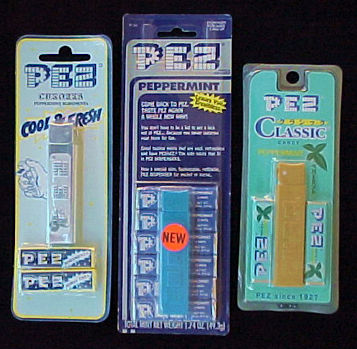 Pictured
on the left are various packaging for PEZ regulars and peppermint
candy packs. These offerings from PEZ are a flashback to
the Golden Age of PEZ, when all the dispensers were regulars
and peppermint was the flavor of choice. The card on the
left is the newer, discontinued Silver Glow dispenser. The
card in the middle is the newer released regular. Note that
the dispenser on this card is one of the "Mono"
or monochromatic regulars. These "Mono Regs" had
the same color plastic on the stem, head (cap), inner sleeve,
and candy button. These had a very limited distribution,
and were quickly replaced by dispensers having the standard
off-white inner sleeve. The card on the right is a Japanese
distributed regular. Note the gold color plastic that was
not available on regulars sold in the US, and the unique
and colorful graphics on the candy packs. Pictured
on the left are various packaging for PEZ regulars and peppermint
candy packs. These offerings from PEZ are a flashback to
the Golden Age of PEZ, when all the dispensers were regulars
and peppermint was the flavor of choice. The card on the
left is the newer, discontinued Silver Glow dispenser. The
card in the middle is the newer released regular. Note that
the dispenser on this card is one of the "Mono"
or monochromatic regulars. These "Mono Regs" had
the same color plastic on the stem, head (cap), inner sleeve,
and candy button. These had a very limited distribution,
and were quickly replaced by dispensers having the standard
off-white inner sleeve. The card on the right is a Japanese
distributed regular. Note the gold color plastic that was
not available on regulars sold in the US, and the unique
and colorful graphics on the candy packs. |
|
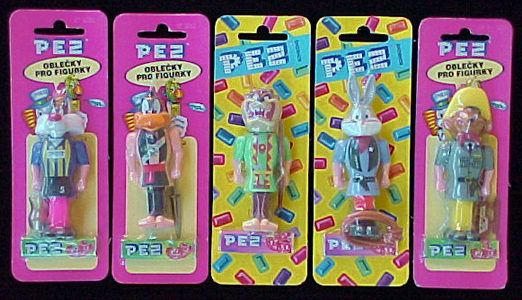
The
Russians are coming... The Russians are coming! These
are the VERY hard to find Russian Body Parts. These body
parts were produced and packaged for the Russian market,
and were different characters than the Body Parts sold
in Canada and European markets. The new characters were
the Soccer Player, Outlaw, Indian, Sheriff, and the General.
The *official* story on these Body Parts is that due to
the downfall of the Russian economy they never made it
into general distribution, and that there were only a
very small quantity of these produced. The hardest to
find character is the General. It is interesting to note
that these Body Parts were packaged on two different styles
of card backs. Some of these cards have Slavic text inside
of a *balloon* coming from Peter Pez's mouth, and Slavic
text on the back. The other card style that these can
be found on is the more generic Euro "Floating Candies"
card. More on that below.
 On
the Russian Body Parts that we have, what I have found
is that the ones with the Slavic text balloon on the front
have all of the usual text on the back (how to assemble,
ingredients, etc.). The ones on the Euro Floating Candies
cards basically have a blank back with only ingredients
and UPC *stickers* on the bottom. It is my opinion that
when the Russian Body Parts order was canceled, PEZ International
thought about repackaging the Body Parts for the Euro
market. They packaged some of the Body Parts on the Floating
Candies cards and did a test release. They must not have
fared well with the buying public, and the Body Parts
were not mass produced for the general public. How many
of these that were produced is still a big question. Their
existence has been known for a few years now, but they
are still rarely seen. It is my opinion that these were
only made in a very small quantity. On
the Russian Body Parts that we have, what I have found
is that the ones with the Slavic text balloon on the front
have all of the usual text on the back (how to assemble,
ingredients, etc.). The ones on the Euro Floating Candies
cards basically have a blank back with only ingredients
and UPC *stickers* on the bottom. It is my opinion that
when the Russian Body Parts order was canceled, PEZ International
thought about repackaging the Body Parts for the Euro
market. They packaged some of the Body Parts on the Floating
Candies cards and did a test release. They must not have
fared well with the buying public, and the Body Parts
were not mass produced for the general public. How many
of these that were produced is still a big question. Their
existence has been known for a few years now, but they
are still rarely seen. It is my opinion that these were
only made in a very small quantity.
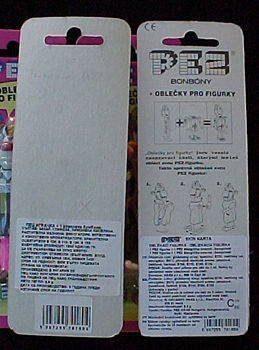
 Helping
to prove my opinion that the Euro packaged Body Parts
were only a test is the fact that the back of the cards
are primarily blank. Pictured to the right is a close-up
of the back of our card with Taz in the Indian Body Part.
Written in pencil is "Tazmanian Devil". This
is further proof to me that these were test pieces. Helping
to prove my opinion that the Euro packaged Body Parts
were only a test is the fact that the back of the cards
are primarily blank. Pictured to the right is a close-up
of the back of our card with Taz in the Indian Body Part.
Written in pencil is "Tazmanian Devil". This
is further proof to me that these were test pieces.
|
|
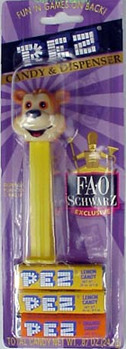 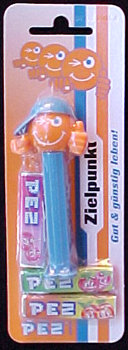
These
are two of only three CUSTOMER specific dispenser card
designs produced by PEZ, with the third being the eBay
Hearts. On the left is the FAO Schwartz Bears. On the
right is the Zielpunkt dispenser made for Zielpunkt grocery
stores in Europe.
|

Pictured
on the right are three Canadian Batman cards. These are
an interesting assortment. For whatever reason, PEZ International
put together a set of Batmans that included the current
Dark Knight (on his typical navy blue stem - not pictured),
a Dark Knight on a light blue stem (middle card), a Small
Headed light blue Batman (that had been discontinued -
pictured on the left), and a Small Headed (black) Batman
on a light blue stem (pictured on the right)! This assortment
featured an all new backing card graphic.
|
|
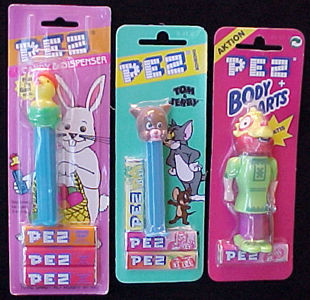
Some additional card graphics are pictured to the left.
The first card is a US blister pack with an Easter Holiday
card and 3.9 Soft-Shell Chick in Egg. The card in the
middle is a Tyke on a Euro card with a Tom and Jerry graphic.
The card on the right is a special Euro Body Parts card
that includes a dispenser. Note the stem color variation
on the PEZ-A-Saur.
|
|
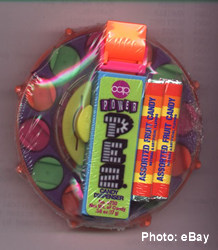
This picture shows the first released Power PEZ, an unique
dispenser that shoots out PEZ candies as the internal
dispenser wheel rotates. The original Power PEZ had overwrap
shrink film packaging, and included two packs of candy.
The second release of this dispenser used a blister pack
card for the Power PEZ and candy packs.
|
|
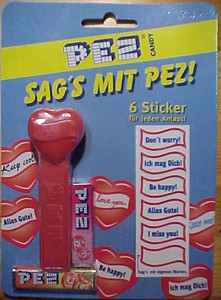
Another test piece was the Sag's Mit PEZ (translated:
"Say it with PEZ") . PEZ International's concept
was based upon *conversational hearts*. On this test piece,
they provided a "blank" Valentines heart dispenser
and six stickers that could be applied to the banner portion
on the heart. This was a limited production test run that
was not released outside of the European market. It is
unclear as to why PEZ International did not mass produce
this item.
|
|
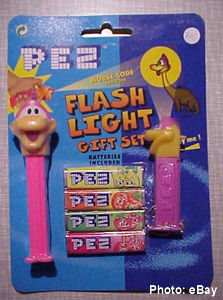
Yet another unique packaging concept from PEZ International.
This was a two-piece gift set that included a PEZ-A-Saur
and its matching keychain flashlight, plus four candy
packs. Hmmm, how come all of the creative packaging styles
and dispenser sets always seem to be generated from PEZ
International?
|
|
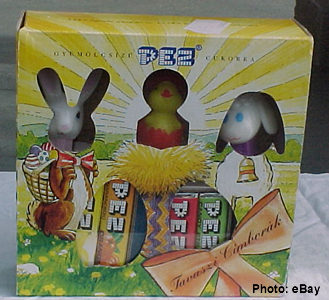 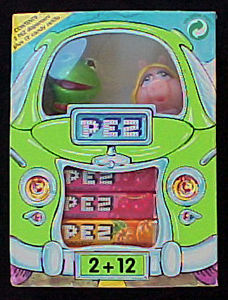
The
two pictures above show two different types of gift boxes.
The picture on the right is of a three-dispenser gift
box with candy packs in an Easter Holiday theme. The front
of the box has a very colorful graphic, with five die-cut
cutouts to show the three dispensers and candy packs.
The picture on the right is a "Car Box" gift
set, that takes it name from the graphic design of a car
with a windshield cutout, so it appears that the two dispensers
are riding in the car. There were three different sets
of dispensers used in this gift set... each had a male
/ female dispenser theme... and consisting of either Kermit
the Frog / Miss Piggy, or Mickey Mouse / Minnie Mouse,
or Donald Duck / Daisy Duck.
|
|
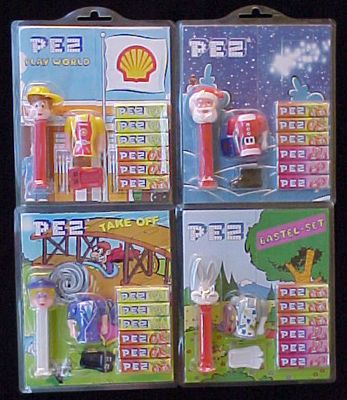
These
are pictures of various Bastel Playworld sets. There were
seven different sets... Shell, Santa Claus (Christmas),
Take Off - Airplane, Easter (all pictured on the left)...
and Aral, British Petroleum, and Mariner sets (not pictured).
Each set had a specially painted Body Part and dispenser,
and featured a tri-fold scenery background and a sheet
of punch out props to help complete the scene. When assembled,
these sets would make up a complete playset based upon
the particular theme.
|
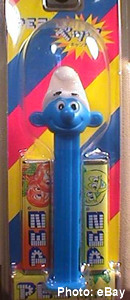 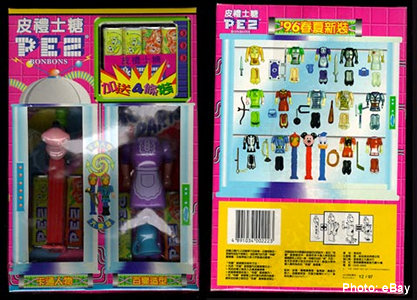
Shown
above are two different Japanese packaging types. The
one on the left is a *hard bubble* blister style pack.
The Japanese use a thicker, more crush-resistant plastic
bubble on their blister style packaging. The picture
on the right shows a dispenser and Body Part gift set.
|
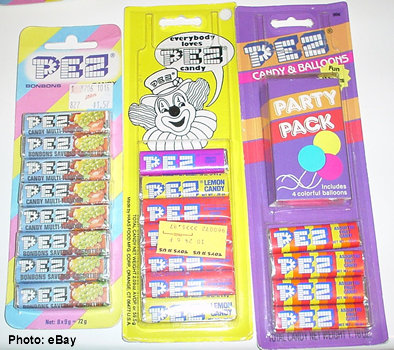
Shown
above are some different types of carded refill candy
pack packaging. The card on the left is a discontinued
Canadian "Halo" card. The card in the middle
is a US refill candy card pack with an interesting Peter
PEZ graphic. The card on the right is a cool variation
where PEZ packaged four packs of candy with some party
balloons, called a "Party Pack". It is my
guess that PEZ put this packaging combo together to
be used as party favors for kid birthday parties.
|
|
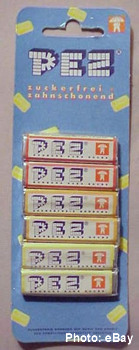 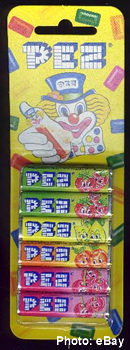 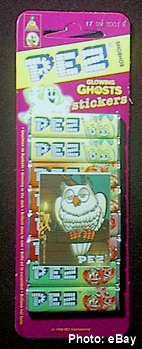
Some
more carded candy packs! On the left is a discontinued
Swiss card with sugar-free candy packs. Note the cool
"tooth" logo on each pack. The candy card in
the middle is a Spanish refill card that uses the Euro
"Floating Candies" card design. The carded refill
pack on the right is a newer Euro design, with graphics
that match the ones used with the Glowing Ghosts dispensers.
Packaged on the card with the candy packs is a peel-off
sticker. Stickers are getting to be a common add-on with
most Euro candy cards.
|
|
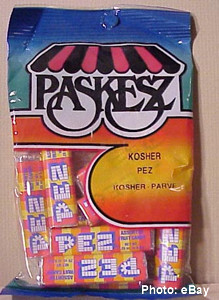
This
is a bag of "Kosher" packaged candy packs.
|
|
|

